
1. Limitations of Direct Ammonia Adsorption by Ordinary Pillared Activated Carbon
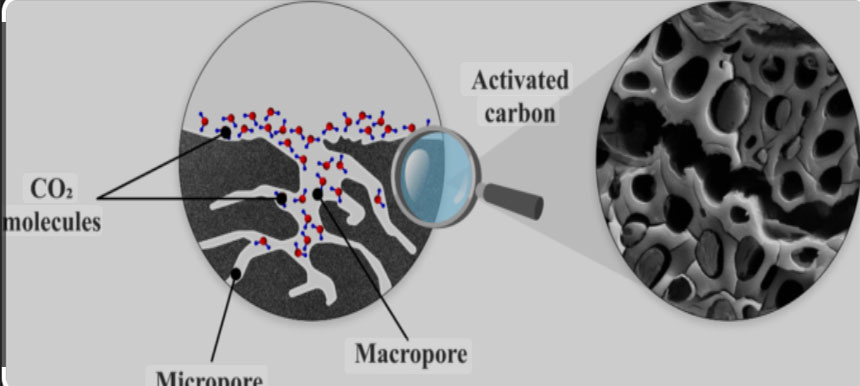
Physical adsorption is the primary mechanism: Ordinary activated carbon relies primarily on its large surface area and rich microporous structure for physical adsorption via van der Waals forces.
Characteristics of the Ammonia Molecules: Ammonia molecules (NH₃) are polar, have a low molecular weight, and are readily soluble in water. These characteristics lead to:
Competitive adsorption: In a water-rich environment (such as the vapor emitted from an ammonia solution), water molecules will strongly compete with ammonia molecules for adsorption sites on the activated carbon, significantly reducing its ammonia adsorption capacity.
Low Adsorption Capacity: Pure physical adsorption has a weak affinity for ammonia, resulting in a low saturation adsorption capacity.
Easy Desorption: Physical adsorption is weak, and adsorbed ammonia molecules are easily desorbed by temperature fluctuations or pressure drops, causing secondary contamination and making recovery difficult.
Therefore, directly using ordinary pillared activated carbon to treat ammonia solutions (or their vapors) is inefficient and uneconomical.

2. Modified Pillared Activated Carbon (Chemical Impregnation) is the Key to Efficient Recovery
To overcome the aforementioned limitations, chemically modified (impregnated) pillared activated carbon is widely used in industry. The principle of modification is to use activated carbon as a carrier and load it with specific chemicals, transforming physical adsorption into chemical adsorption.
Common Impregnants:
Phosphoric acid (H₃PO₄): The most commonly used impregnant. Phosphoric acid reacts with ammonia to form ammonium phosphate, which is stably fixed in the pores of the activated carbon.
3NH₃ + H₃PO₄ → (NH₄)₃PO₄
Sulfuric acid (H₂SO₄): Reacts with ammonia to form ammonium sulfate.
2NH₃ + H₂SO₄ → (NH₄)₂SO₄
Other Acidic Substances: Organic acids such as citric acid.
Working Principle:
The surface of the modified activated carbon is filled with acidic functional groups.
When ammonia-containing gas passes through the carbon bed, ammonia (alkaline) undergoes an irreversible acid-base neutralization reaction with the acidic sites.
The resulting ammonium salt is firmly fixed to the activated carbon.
Advantages:
Significantly improved adsorption capacity: Stoichiometric reaction: Theoretically, 1g of phosphoric acid can adsorb approximately 0.62g of ammonia, far exceeding physical adsorption.
High selectivity: High selectivity for ammonia is maintained even in humid environments, with minimal interference from water vapor.
More stable: The salts generated by the reaction are not easily desorbed until the activated carbon reaches saturation.
3. Typical Application Processes in Ammonia Recovery Systems
Pillar activated carbon (usually modified carbon) is primarily used in ammonia recovery systems in an "adsorption-desorption" process to recover ammonia and regenerate the activated carbon for reuse. A typical process is as follows:
Application scenario: Treatment of ammonia-containing waste gas (e.g., ammonia-containing air generated by chemical production, fertilizer plants, refrigeration plants, and landfill leachate treatment plants).
Process Flow:
Adsorption Stage:
Ammonia-containing waste gas is fed via a blower into an adsorption tower filled with modified columnar activated carbon.
Ammonia is chemically adsorbed and fixed by the activated carbon, and the purified, qualified gas is discharged from the top of the tower.
This process continues until the activated carbon is nearly saturated (the outlet ammonia concentration exceeds the standard).
Desorption/Regeneration Stage:
A valve is switched to stop air flow to the saturated adsorption tower, entering regeneration mode.
Hot steam (above 100°C) is introduced into the carbon bed. The heat breaks the chemical bonds between the ammonia and the impregnant, causing the ammonia to be desorbed.
The desorbed, high-concentration ammonia-water vapor mixture is discharged from the top of the tower.
Condensation Recovery:
The high-concentration ammonia-water vapor enters the condenser and is condensed by cooling water.
Because ammonia is readily soluble in water, a high-concentration ammonia solution is formed.
The non-condensable gas (primarily air) is minimal and can be returned to the adsorption front end for further treatment or discharge.
Activated Carbon Drying and Cooling:
The regenerated carbon bed is damp and requires drying with hot air, followed by cooling to room temperature with cold air.
At this point, the activated carbon regains its adsorption capacity, and the system is ready to begin the next adsorption cycle.
Ammonia Solution Distillation (Optional):
The recovered high-concentration ammonia solution can be further purified through a distillation tower to produce a higher-purity liquid ammonia product, enabling resource reuse.
4. Advantages and Precautions of Pillared Activated Carbon
Advantages:
Regular shape: Uniform bulk density, low airflow resistance (low pressure drop), suitable for filling large adsorption towers.
High strength: Resistant to pulverization, long service life.
Easy to modify: Easy to acid impregnate.
Precautions:
Safety: Modified activated carbon is inherently acidic, requiring proper handling precautions. Adsorption is exothermic, so excessive bed temperature rise must be prevented when treating high-concentration waste gases.
Equipment Corrosion Prevention: Both ammonia and acidic impregnants are corrosive to metals. Therefore, adsorption towers, piping, and other components must be constructed of corrosion-resistant materials such as fiberglass and stainless steel.
Regular Replacement: After repeated adsorption-desorption cycles, the impregnant will gradually deplete and lose adsorption efficiency, requiring regular monitoring and replacement of the carbon.
Summary
Pillar activated carbon is a core adsorption material in ammonia solution (waste gas) recovery systems, but its efficient application relies on the crucial "chemical modification" step. Through the "adsorption-vapor desorption-condensation" process, it effectively enriches and recovers ammonia from low-concentration industrial ammonia-containing waste gas, generating a reusable ammonia solution, ultimately achieving both environmental and economic benefits.
 Get Free Sample
 WhatsApp